Kanban vs Outliner: The Answer Is Usually Both
They answer different questions. Kanban answers “where is it”. An outliner answers “what is it part of”.
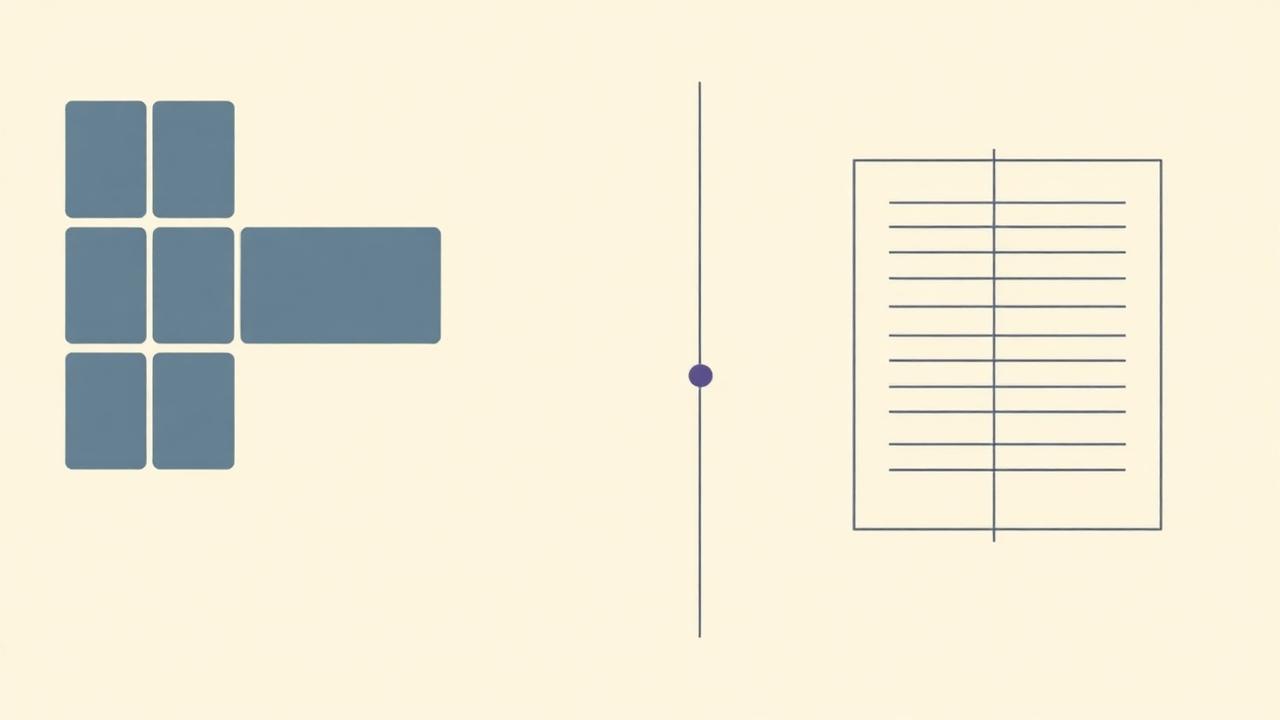
“Should we use Kanban or a task list?” is the wrong question. The two aren't competing approaches to the same problem; they're answers to different questions about the same work.
Kanban answers “where is this in the workflow?” An outliner answers “what is this and how does it relate to everything else?” Teams get into trouble by picking one and living with the other's absence.
What Kanban is optimised for
A board visualises workflow state. Columns are stages, movement left to right is progress, and the whole thing answers “what's blocked?” and “what's moving?” in one glance.
It's excellent for stand-ups, reviews and continuous-flow work. Its limitation is structural: hierarchy is flattened out of existence, and fifty cards in a column are exactly as overwhelming as fifty lines in a list.
What outliners are optimised for
An outliner visualises belonging. Indentation means containment, and the view answers “what is this work?” and “what is it part of?”
It's the right surface for planning, brainstorming and building a work breakdown. Its limitation is the mirror image of Kanban's: structure is obvious, status is not. You can't see everything in progress across the tree without expanding all of it.
Kanban flattens structure. Outlines hide status. Picking one permanently means living with the missing half.
The pattern good teams already follow
Watch a high-functioning team and you'll see both views used without anyone naming the practice. They outline the work at the start of a sprint, run stand-up from the board, and jump back to the outline when requirements move.
The failure mode is identity: becoming “a Kanban team” that struggles with anything structurally complex, or “an outliner team” that can never say what's in flight today.
Plan in the outline, execute on the board
Sprint planning: outline view, build the epic → story → task hierarchy, assign. Daily stand-up: board view, move cards. Mid-sprint change of scope: outline view, reshape the tree. Review: board view, present the Done column.
The view follows the purpose of the moment. Any workflow that requires the meeting to adapt to the tool has it backwards.
Why switching should be free
In Taskpend the same tasks render as an outline, a Kanban board, a spreadsheet, a Gantt timeline or a document, with no export step and no data transformation.
The structure you built in the outline is preserved on the board; the status you set on the board is visible in the outline. When switching costs nothing, teams stop arguing about which view is correct and start using the one that fits the question.
Takeaways
- Kanban answers status questions; outlines answer structure questions.
- Most good teams already alternate between them, informally.
- Plan in the outline, execute on the board, review on the board.
- The switch should be free — one dataset, many views.
Taskpend is a nested outliner with mirrored tasks, six views and AI agents that execute. Free for individuals.